



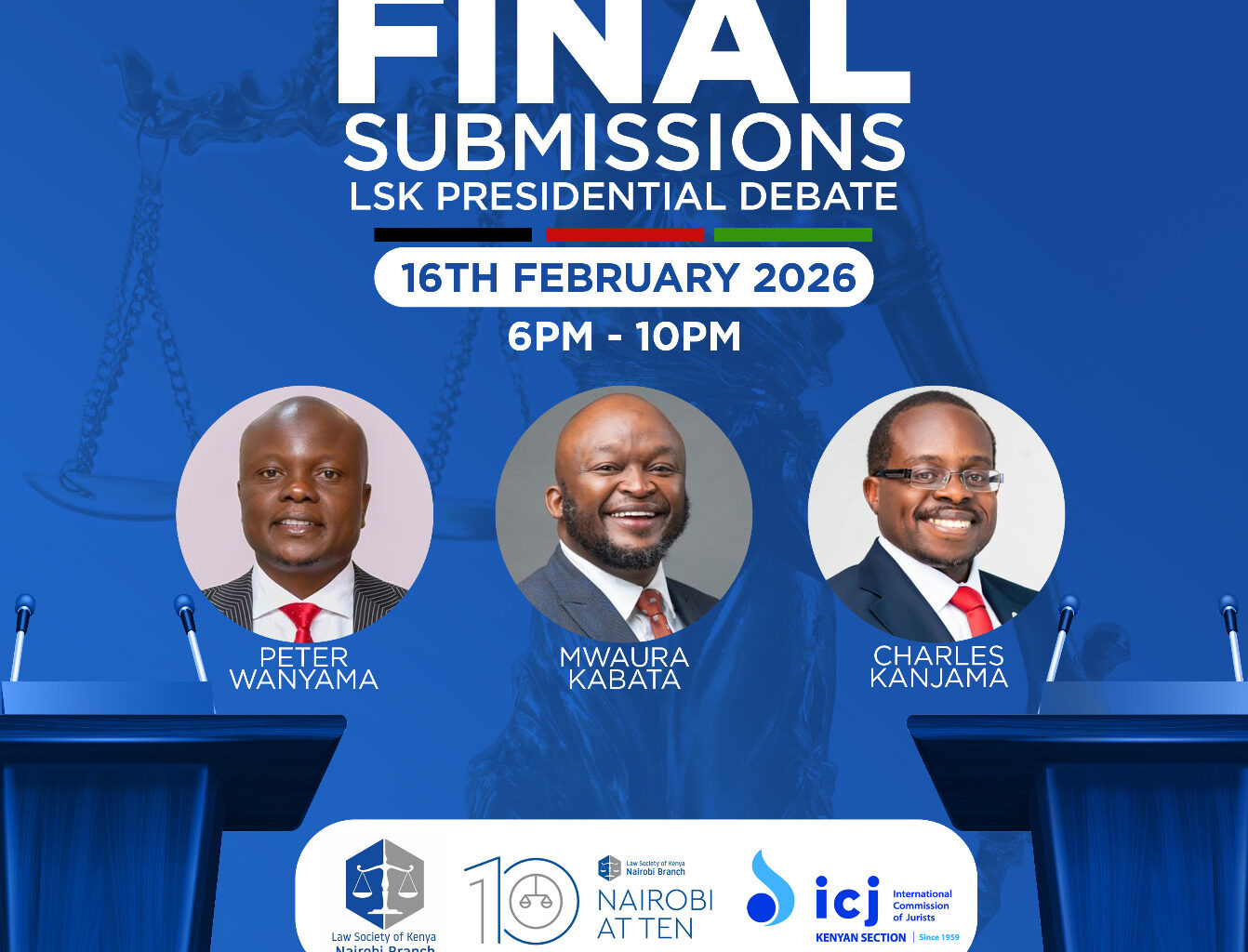
The International Commission of Jurists (ICJ) is one of the official sponsors of the final Law Society of Kenya (LSK) Presidential Debate for the 2026-2028 election cycle.
The debate, titled “The Final Submissions,” is taking place on February 16, 2026 at the Catholic University of Eastern Africa (CUEA).
The debate will feature three legal minds Peter Wanyama, Mwaura Kabata, and Charles Kanjama who are competing to succeed the incumbent, Faith Odhiambo, in an election scheduled for February 19, 2026.
Faith Odhiambo has served in the office for two terms.
The candidates profiles are as follows:
- Charles Kanjama, SC
He is a seasoned legal practitioner with over 20 years of experience, who was conferred the rank of Senior Counsel (SC) in 2022.
He served as the inaugural chairperson of the LSK Nairobi Branch between 2016 and 2020 as well as the chairperson of the LSK Caucus of Branch Chairs.
Running under the acronym “RIPE” (Rule of Law, Integrity, Practice & Welfare, and Engagement). He positions himself as a “steady hand” focused on ethical leadership and finishing the Wakili Towers project whose groundbreaking was overseen by the outgoing president.
2. Mwaura Kabata
He is the current LSK Vice-President (2024–2026) and a senior partner at Alakonya Law LLP, specializing in dispute resolution.
Kabata is known for his active involvement in public-interest litigation, notably defending constitutional rights during the 2024-2025 Gen Z protests.
The vice president is running on “A Brave, Bold and Boundless LSK” slogan. His focus is on continuity of current leadership initiatives, digital transformation (paperless LSK), and making Wakili Towers a revenue-generating asset to reduce member subscriptions.
3. Peter Wanyama
He is an advocate with 18 years of experience, and finished as the runners-up in the 2024 election.
Wanyama is a consultant in legislative drafting, having participated in the creation of over 32 statutes for government agencies.
He positions himself as a reformist candidate advocating for “strategic, purposeful, and strong leadership”.
His agenda highlights the mental health crisis among lawyers, financial support for regional branches, and expanding economic opportunities beyond traditional litigation.