




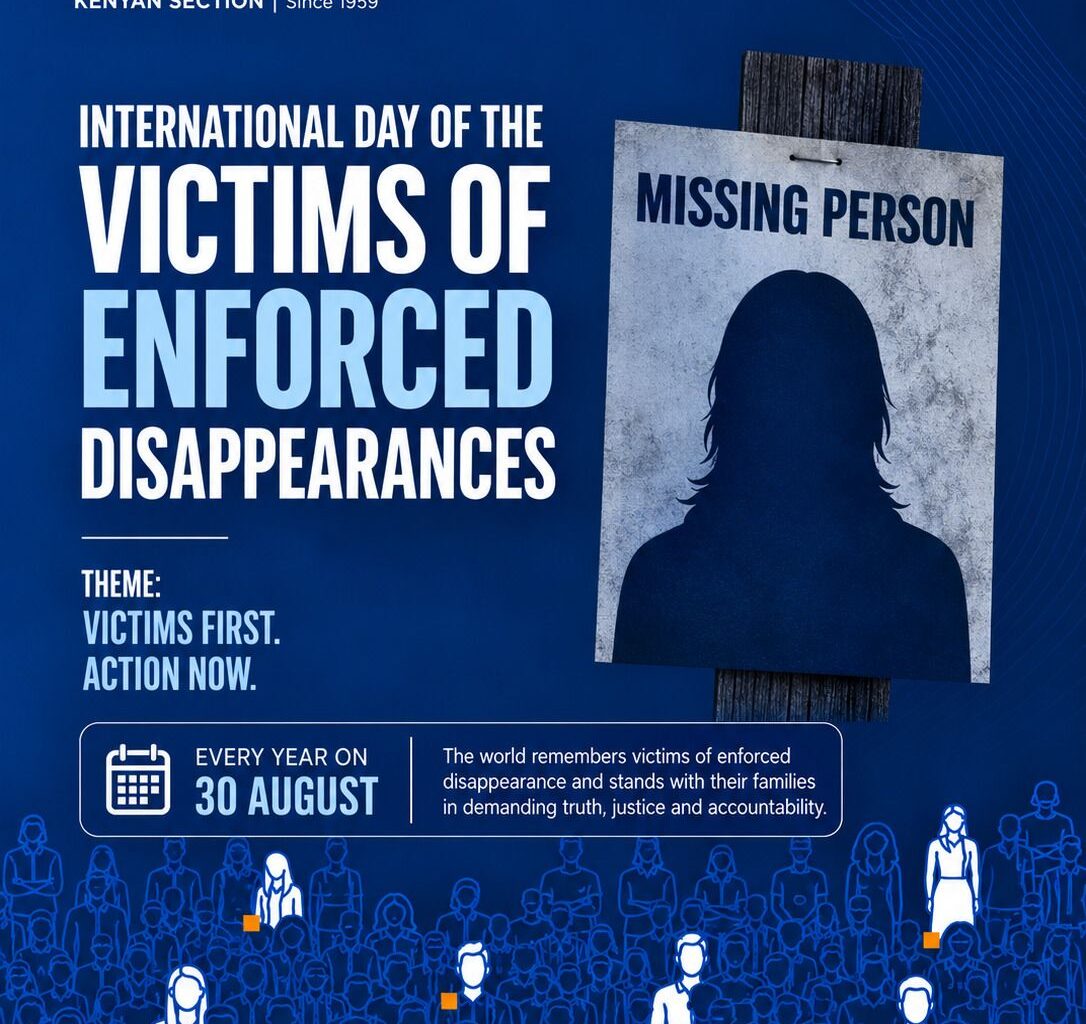
An enforced disappearance happens when a state takes, hides, or detains a person against their will, and then refuses to say where they are or what happened to them. Enforced disappearance is not simply the disappearance of an individual; it denies a person the protection of the law, hence leaving families and friends in uncertainty about the fate and whereabouts of their loved ones.
As the world commemorated the International Day of the Victims of Enforced Disappearances on 30 August 2026, ICJ Kenya called for and continues to call for renewed attention to the continuing reality of enforced disappearances in Kenya, Sudan, and across East Africa. This provides an important opportunity to reflect on the experiences of victims and their families, strengthen efforts to prevent enforced disappearances, and demand accountability for those responsible.
In Kenya, allegations of abductions and enforced disappearances, particularly involving government critics, human rights defenders and protesters, raise serious concerns about accountability and respect for constitutional rights. The existence of strong constitutional protections has less meaning if individuals can be taken away without their families or friends knowing where and why they are being held. Every allegation must be promptly and independently investigated, and victims and their families must have access to justice and reparations.
Following the protests that occurred on 25 June 2026, the Kenya National Commission on Human Rights (KNCHR) documented seven incidents of enforced disappearance of peaceful protesters. Six protesters were reportedly arrested outside Parliament, placed in a police truck and taken away, while efforts to locate them were unsuccessful and they were not booked at police stations.
In Sudan, the ongoing conflict between the Sudanese Armed Forces (SAF) and the Rapid Support Forces (RSF) has created conditions in which arbitrary detention, torture, abductions and enforced disappearances have become tools of control. The conflict must not be allowed to obscure the rights of victims or prevent families and friends from knowing the fate of their loved ones. International humanitarian and human rights law continue to apply during armed conflict. In June 2026, the UN Human Rights Office reported that Sudan’s warring parties were increasingly using arbitrary detention, torture and enforced disappearance as tools of control. The African Commission on Human and Peoples’ Rights has also reported that the UN Committee on Enforced Disappearances had registered 17 cases concerning Sudan by May 2025, involving allegations against both the RSF and SAF.
This is particularly alarming because conflict creates conditions in which families may have little ability to search for missing relatives, access detention facilities, obtain legal assistance or demand accountability. A person who disappears in a war does not become less entitled to protection.
The consequences of enforced disappearance extend far beyond the individual as families are forced into a painful cycle of visiting police stations, hospitals, and courts, desperately trying to establish whether their loved one is still alive. The disappearance of a family’s breadwinner can also create economic hardship, while children may be left without parental care.
Although Kenya and Sudan face different circumstances, both demonstrate the dangers of secrecy, weak accountability and impunity. Governments and armed actors must ensure that every person deprived of liberty is officially recorded, protected from torture and brought before competent judicial authorities.
Several mechanisms exist to address enforced disappearances. The UN Working Group on Enforced or Involuntary Disappearances and the UN Committee on Enforced Disappearances monitor cases, engage States and seek accountability. The African Commission on Human and Peoples’ Rights provides an important regional mechanism for addressing violations and promoting truth, justice and reparations. For Kenya and Sudan, stronger cooperation with these mechanisms, alongside effective national investigations and judicial processes, is essential to combat impunity and ensure justice for victims and their families.
In Kenya, the lesson must be that constitutional rights cannot stop at the doors of police stations and security facilities. In Sudan, the lesson must be that war cannot erase the obligations owed to civilians. And across Africa, the message must be unequivocal: No government, security agency or armed group should have the power to make a person disappear and make the truth disappear with them.
Victims must come first, families must be heard, the missing must be found, truth must be established, perpetrators must be held accountable, and the law must follow every person even when they have been taken into the darkness.
Every missing person has a name, a family, friends, and a right to be found. The missing must be found, the truth established, and perpetrators held accountable.
Writer, The International Commission of Jurists- Kenyan Section (ICJ Kenya)